The Toothbrush Analogy
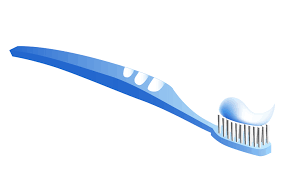
I want you to think of your relationship with healthy eating a lot like your relationship to brushing your teeth.
Brushing your teeth is something you do regularly, right?
Correct me if I’m wrong, but my guess is that it’s part of your daily routine; something that doesn’t require epic willpower to do and stick with.
Most likely you don’t need to set a New Year’s resolution to “start brushing your teeth” once the holidays are over (flossing is a whole other story, haha, so stick with tooth brushing for now as we talk through this analogy).
You also probably don’t stop brushing your teeth as you’re preparing to move, or when you’re on a tight work deadline, or when you go on vacation.
Although you probably brush your teeth consistently , unless you have absolutely perfect dental hygiene, I bet there has been the odd night where you’ve just been too tired, or so busy, that you’ve passed out into bed exhausted, too tired to brush your teeth . (I’m going to out myself here and admit to doing that, rarely, but from time to time it’s happened. Whoops!)
Imagine you went to bed on a Thursday night and forgot to brush your teeth before going to sleep. How would you handle that? Would you wake up on Friday morning, hating yourself as a person, and calling yourself all kinds of awful names and feeling like a big failure?
Imagine this crazy internal self-talk:
“Stupid idiot! You’re such a failure. Well, since you blew it, you might as well go on a sugar bender this weekend. Let’s get the teeth all nice and fuzzy with candy on Friday, Saturday, and Sunday. No teeth brushing, and all the junk food you’ve been avoiding since you’ve blown it. If you’re going to be bad, you might as well be really bad since you’ve already screwed things up. But on MONDAY, yes, Monday, that’s the perfect day to get back on track and get back to brushing your teeth.”
Sounds ridiculous, no?
Now imagine this equally ridiculous reaction:
“Oh no! I’ve made the biggest mistake ever. I need to fix this NOW! I should call my dentist for an emergency teeth cleaning appointment, and ask them to schedule me in ASAP. And you know what, maybe the way I was brushing my teeth wasn’t the “right” way to do things. Yes, that’s why I screwed up. I should jump on the internet and research this in more detail. Maybe I need to switch toothbrushes? Or maybe it’s my toothpaste that’s the issue and I need to make a change? Maybe there’s a tooth brushing support group I can join on social media and post a message there, just to see what others are saying or if they have any advice for me? You know what, Janice at my office has really nice teeth. I should ask her what she’s doing, and copy that. I just need to research and learn more about the BEST way to brush my teeth, that way, I’ll get the BEST results and won’t be such a screw up.”
Clearly, that is also a giant over-reaction, and is equally unsupportive and unproductive.
What actually happens in real life if you forget to brush your teeth? Most likely you simply wake up the next morning, shrug it off, and go directly to the bathroom and brush your teeth. No biggie.
You don’t overthink it.
You don’t beat yourself up or call yourself terrible names.
You don’t wait for the “right time” to fix things.
You don’t start researching a “better” way to do something that was already “good enough”.
You don’t make it worse, or stop a positive habit, just because you were a tiny bit off track.
You don’t replay it in your head all day long.
You don’t talk about it with a therapist, or your friends, or on the internet.
You don’t adjust your habits, and brush your teeth twice as hard, or for twice a long, to “make-up” for it.
Your HEALTHY HABITS, POSITIVE ROUTINES, and SUPPORTIVE ENVIRONMENT pull you back on track, without a second thought.
And why for 99.9% of the population is brushing our teeth something that’s fairly easy to do (assuming you don’t have a precarious living situation, which is a totally different issue related to the social determinants of health)?
- Because we’ve shrunken down the task of brushing our teeth to a “good enough” < 5 minute action, and we’ve practiced it with consistency over decades of our lives.
- We don’t worry about being perfect.
- We don’t waste time researching the perfect toothbrush, or the perfect toothpaste (unless you’re really into that stuff).
- We don’t ask ourselves to make homemade toothpaste from scratch every single night.
- We don’t go on a wild goose chase looking for a hidden toothbrush each day, sometimes having it turn up in our freezer, or hidden in the glovebox of our car, or in the back of a closet.
Everything we need to be successful, every single day, is sitting right there in our bathroom by the sink. Our expectations of ourselves are realistic, and are not based on perfection. If we do get off track, it really isn’t a big deal, and we return right back to the consistent positive habit as soon as we’re able to, without changing our course of action or beating ourselves up.
Imagine now, if you took this toothbrush mindset, and applied it to healthy eating. You found something that worked good enough , that you could do consistently for the long-run. And if you did get off track, you didn’t wait days for the perfect time to start over, and just tried your best to make a good enough choice, the next time you selected something to eat. And imagine if your inner bully was as quiet as the voice that addressed forgetting to brush your teeth (silent). Imagine what that mindset shift might do, when it comes to transforming your relationship with food and self-talk?
Book a free intro to see how we can help!
The post The Toothbrush Analogy appeared first on CollectiveFit.
More Posts